Climate change and supply chains
2026 is expected to be one of the four hottest years ever recorded, continuing a run of years above 1.4°C warming. The UK recorded its warmest and sunniest year on record in 2025, with an average temperature of 10.09°C, surpassing all previous records dating back to 1884 (ref.1).
In early 2026, global temperatures have reached nearly 1.5°C above pre-industrial levels, with February ranking among the warmest ever recorded. At the same time, Arctic sea ice and snow cover continue to shrink to historic lows - clear signs that climate volatility is no longer episodic, but systemic.
For supply chains, temperature excursions are no longer rare disruptions, they are an expected part of managing business. It is a present, operational reality, reshaping how goods are produced, transported and protected.
This is not just a climate story. It is a supply chain story.
The Hidden Risk of Climate Change: Temperature Exposure
As temperatures rise and weather patterns become more volatile, the risk to temperature-sensitive products increases dramatically.
- Food spoils faster in higher ambient heat
- Pharmaceuticals degrade outside strict temperature ranges
- Chemicals and diagnostics become unstable
- Logistics routes are disrupted by heatwaves and extreme weather
Crucially, these risks are often invisible. A shipment may look intact on arrival, but its integrity may already be compromised.
And as climate volatility increases, so does the frequency of these ‘silent failures’.
From Exception to Everyday Risk
Historically, extreme heat events were rare. Today, they are becoming routine.
According to the UK Met Office, a year as warm as 2025 is now expected to occur roughly once every three years in the UK’s current climate. In other words, what was once exceptional is now part of the baseline.
For supply chains, this creates a fundamental shift:
- Temperature excursions are no longer edge cases
- Risk is no longer seasonal
- Monitoring can no longer be optional
Timestrip Indicators: Certainty in an Uncertain Environment
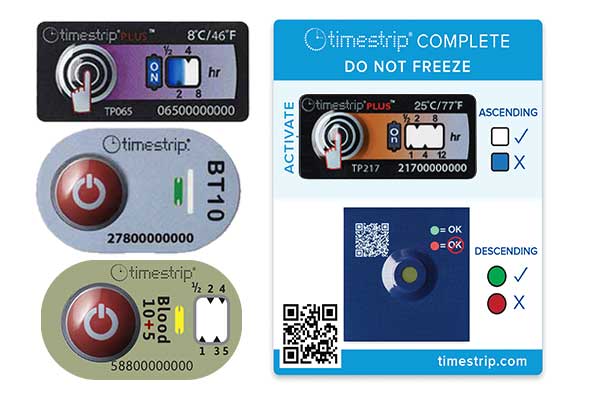
This is where monitoring with temperature and time indicators such as those from Timestrip becomes critical. Timestrip’s products are designed to provide clear, visual evidence of time and temperature exposure, without the need for complex electronics or infrastructure.
Examples from the Timestrip range:
1. Irreversible temperature indicators
Used widely in pharmaceuticals and food logistics, these labels show a permanent change when a product exceeds a predefined temperature threshold. → Ideal for identifying heat exposure during transport or storage
Read more about Timestrip PLUS temperature indicators >
2. Time–temperature indicators (TTIs)
These track cumulative exposure over time, not just a single breach. → Critical for products where degradation depends on duration as well as temperature
Read more about Timestrip food temperature monitoring >
3. Event indicators (freeze / heat breach)
Designed for sensitive goods like vaccines, these show if a product has been exposed to damaging conditions, even briefly. → Enables instant pass/fail decisions at the point of use
Read more about Timestrip neo electronic temperature indicators >
Why Temperature Monitoring Matters More Than Ever
In a stable climate, businesses could rely on:
- Established logistics routes
- Predictable seasonal patterns
- Controlled storage environments
That stability is eroding. With higher temperatures and more frequent extremes:
- Refrigeration systems are under greater strain
- Transit times are less predictable
- Exposure risks increase at every handoff
The consequences of failure are rising too:
- Financial loss from spoiled goods
- Regulatory non-compliance
- Reputational damage
- Patient or consumer safety risks
From Monitoring Temperature to Visual Proof
Timestrip’s time and temperature indicators turn invisible risk into visible evidence:
- Was the product exposed?
- For how long?
- Is it likely to be still safe to use?
In high-pressure environments, whether a hospital, warehouse, or last-mile delivery, this kind of clarity is invaluable.
Conclusion: Designing for a Hotter World
As the climate continues to warm, resilience will become a defining feature of successful supply chains.
That resilience depends on three things:
- Visibility – knowing what conditions products have experienced
- Simplicity – solutions that work anywhere, instantly
- Accountability – being able to prove compliance
Timestrip solutions are an indispensable aid to resilience.