
Beyond the Bottleneck: Managing Thermal Risks Due To Protracted Freight Delays
In our previous article, Temperature Monitoring in Freight Disruptions, we began to explore the important role of cold chain visibility during logistical hiccups. However, in recent times, the global logistics landscape has shifted from ‘disrupted’ to a more protracted crisis.
With major maritime arteries seeing unprecedented congestion, and port dwell times exceeding three weeks in key hubs, the threat to temperature-sensitive cargo, such as food and pharmaceuticals, has reached a critical flashpoint. When freight stops moving, the risks do not remain static, they accelerate.
The March 2026 Context: Delays Equal Heat
The current delays are not merely a matter of lost time, they are a matter of ‘thermal accumulation’. In the northern hemisphere’s early spring, shifting weather patterns and the intensified ‘urban heat island’ effect at major trans-shipment ports mean that containers sitting on docks are exposed to internal temperatures far exceeding ambient air levels.
Much of the Middle East has seen an upward trend in extreme heat days over the last decade, and in March 2026, many central regions are experiencing an earlier than usual transition into summer heat, which is putting additional pressure on cold-chain logistics for sensitive freight.
For ‘passive’ shipping containers (those relying on insulation and phase-change materials rather than active refrigeration), a delay of even 48 hours beyond the validated duration can lead to a catastrophic thermal excursion.
Even for ‘active’ reefer containers, prolonged dwell times can lead to power-source failures and fuel exhaustion for cooling units, leaving life-saving medicines and perishable foods vulnerable.
The Biological and Chemical Cost of Delay
1. Pharmaceuticals: The "Invisible" Decay
Unlike food, pharmaceutical degradation is often invisible. In March 2026, we are seeing a spike in Mean Kinetic Temperature violations.
- Biologics and Vaccines: Many of the therapeutics currently stuck in transit are protein-based. High-temperature exposure causes these proteins to denature or unfold. A vaccine that sits for hours while awaiting a redirected flight may look identical to a potent one, but its efficacy may be reduced to zero.
- Shelf-life Acceleration: For every 10°C increase above the recommended storage temperature, the rate of chemical degradation typically doubles or triples. A two-week delay in a hot port can effectively ‘age’ a pharmaceutical product by several months.
2. Food Safety: The Microbial Clock
For the food industry, supply chain delays can create a ‘perfect storm’ for spoilage.
- Pathogen Proliferation: Bacteria such as Salmonella and Listeria thrive in the ‘danger zone’ (4°C to 60°C). As refrigerated containers lose power during port backlogs, internal temperatures quickly climb into this range.
- Ethylene Buildup: In produce, delays cause an accumulation of ethylene gas. When combined with rising temperatures, this accelerates ripening and decay, turning a shipment of premium fruit into waste before it even clears customs.
Visual Indicators as a Line of Defense
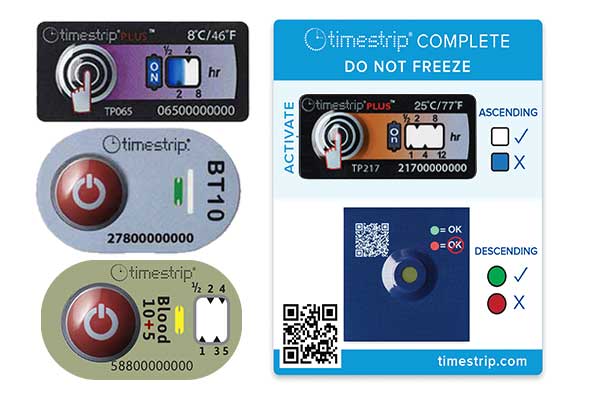
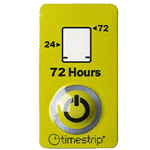
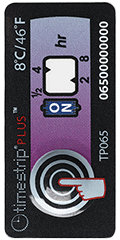
Timestrip technology in the form of visual time and temperature Indicators becomes even more valuable during periods of freight disruption. These low cost devices provide an immediate indication of whether temperatures have been breached.
The irreversible alerts are easy to read and interpret, either as colour change temperature breach recording or flashing LED breach alerts, making them suitable for even untrained personnel.
Depending on how goods are packed, air will follow the path of least resistance and may bypass part of the cargo entirely. Since Timestrip indicators are very small and light, they can be attached directly to the primary packaging or outer carton throughout a container or refrigerator, enabling temperature gradients to be discovered.
While digital loggers provide great data, they don't always offer the immediate, "Go/No-Go" clarity needed in a busy supply chain.
Timestrip visual indicators act as an irreversible alert to breached conditions. Small, light, and low-cost, they can be attached directly to primary packaging or outer cartons to:
- Detect temperature gradients: Identify hot spots within a container where air may have bypassed the cargo.
- Empower untrained personnel: Using simple colour changes or LEDs to signal a breach instantly.
- Ensure integrity: Provide point-of-use verification that the product has not been exposed to adverse temperature conditions.
Implementing simple irreversible visual indicators on every pallet helps ensure that despite delays, the safety of our global food and medicine supply remains uncompromised.
.