
WHO Guidelines and Timestrip Indicators
This article draws on the World Health Organisation Model Guidance for the Storage and Transport of Time- and Temperature-Sensitive Pharmaceutical Products, and the role of Timestrip indicators for temperature monitoring and cold chain assurance. The original WHO document lays out temperature monitoring requirements in broad terms; this article links those principles to practical application of Timestrip devices.
Ensuring Cold Chain Integrity: How WHO Guidance Aligns with the Use of Timestrip Indicators
Maintaining the integrity of time- and temperature-sensitive pharmaceutical products (TTSPPs) throughout storage and transport is critical for preserving efficacy, safety and quality. The World Health Organization (WHO) Model Guidance for the Storage and Transport of Time- and Temperature-Sensitive Pharmaceutical Products - Annex 9 of Technical Report Series 961 - sets out widely recognised principles for controlling and monitoring temperatures throughout the supply chain.
Temperature Monitoring in WHO’s Model Guidance
WHO’s Annex 9 emphasises that temperature control and monitoring are fundamental components of good storage and distribution practice for TTSPPs. The guidance includes requirements for:
- Temperature-controlled storage areas with systems that reliably maintain predefined temperature ranges.
- Routine and systematic temperature monitoring within these controlled environments, using calibrated devices that provide accurate records over time.
- Monitoring during transit, including temperature monitoring in vehicles and containers — whether actively cooled (e.g., refrigerated trucks) or passively conditioned (e.g., insulated packaging with coolant).
- Temperature records and alarms to alert responsible personnel promptly when conditions deviate from predefined limits.
- Verification and calibration of all monitoring equipment to ensure it functions as intended over time.
The guidance does not prescribe specific brands or technologies, its broad requirements create a framework within which indicator devices like Timestrip temperature indicators can play a meaningful role.
What Are Timestrip Indicators?
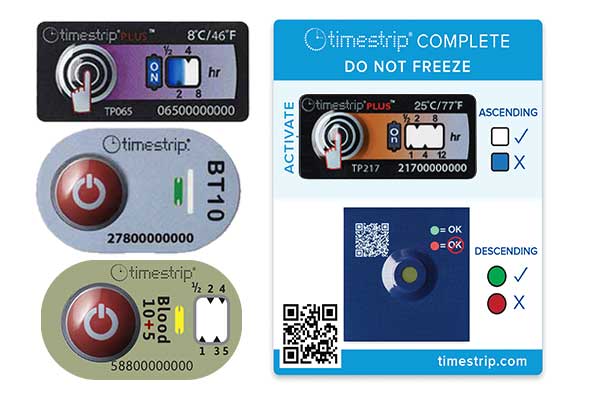
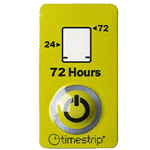
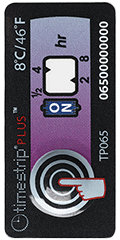
Timestrip liquid-based irreversible indicators are single-use temperature indicator labels that change colour when exposed to, or exceed, specific temperatures. Their electronic equivalents offer more accuracy and show breaches using LED lamps on the front of the device. Electronic indicators may also be supplied as resettable options, allowing multiple uses of each indicator. Both liquid-based and electronic temperature and time indicators are commonly used in cold chain logistics to provide visual evidence of temperature excursions, especially where more complex continuous electronic data logging may not be feasible.
How Timestrip Indicators Complement WHO Expectations
While WHO encourages the use of continuous and calibrated temperature logging systems. Timestrip indicators offer several practical advantages that align with the guidance’s overarching goals:
-
Visual Confirmation of Temperature Exposure
The simplicity of a colour-change indicator provides at-a-glance confirmation that a product remained within its safe temperature range or has exceeded it. For operations without access to real-time digital systems, such as remote storage facilities, secondary transport legs, or contingency inventory, Timestrip indicators offer cost-effective, reliable qualitative monitoring that supports decision-making.
-
Supporting Routine Monitoring and Record-Keeping
WHO’s guidance calls for routine temperature records during storage and transport. While sophisticated electronic devices capture detailed data, indicators like Timestrip can be recorded as part of manual logs, helping teams meet the documentation requirements where electronic systems are unavailable or impractical.
-
Backup and Redundancy
Annex 9 emphasises verification and quality assurance of monitoring systems, including backup processes. Implementing low-cost Indicators alongside digital loggers provides redundancy: if a data logger fails or loses power, a Timestrip still shows whether a critical temperature was breached, supporting WHO’s intent for robust temperature control.
-
Enabling Monitoring in Passive Temperature-Controlled Packaging
The WHO guidance covers temperature monitoring in passive containers, such as insulated boxes used for last-mile delivery. In these cases, an electronic logger may be bulky or expensive. A Timestrip placed in the coldest (or warmest) part of the payload can act as an early indicator of excursion risk, notifying handlers before products are compromised.

Best Practices When Using Timestrip Indicators
To align with WHO expectations and to make the most of Timestrip indicators in a regulated setting:
- Choose indicators with thresholds that match the product’s labelled storage range (e.g.
2°C–8°C for many vaccines). Examples include the Timestrip neo T525-DF, Timestrip Complete 2-8ºC or Timestrip PLUS 8ºC. - Place indicators in representative locations within storage units or transport containers (e.g., near the product, not just on external packaging).
- Incorporate indicators into standard operating procedures and record logs, noting observations and linking them with electronic records when available.
- Use indicators as part of training for staff involved in handling, monitoring, and responding to excursions.
Conclusion
WHO’s Model Guidance for Storage and Transport of Time- and Temperature-Sensitive Pharmaceutical Products sets a high bar for ensuring cold chain integrity through accurate, documented temperature monitoring.
Its principles: visibility of temperature conditions, record keeping and assurance against excursions are supported by the practical use of temperature indicators such as Timestrip devices.
These indicators serve as accessible, visible tools that complement more advanced systems, and help meet WHO’s goals of preserving the quality of TTSPPs throughout the supply chain.