Small Indicators, Big Protection: Why Simple Temperature Monitoring Matters in the Cold Chain
Temperature control is critical whenever products are sensitive to heat or cold. Pharmaceuticals, vaccines, blood products, food, chemicals and many other temperature sensitive goods can be damaged by excursions that occur during storage or transportation.
Yet temperature monitoring does not always need to involve sophisticated electronic data loggers, software or complex monitoring systems. For many applications, a small, inexpensive visual temperature indicator can provide exactly the information that matters. It can show whether a particular product has been exposed to a damaging temperature, and for how long. This simplicity can make time and temperature indicators such as those from Timestrip particularly useful throughout the cold chain.
Why Temperature Gradients Make Small Indicators Essential
One of the assumptions behind conventional temperature monitoring is that the temperature measured at one point represents the temperature experienced by everything around it; in reality, large refrigerators and freezers can have significant temperature variations. The temperature near the door may behave differently from that at the back of the cabinet. Areas close to cooling elements can be colder, while other areas may be warmer.
The same principle applies during transportation. A refrigerated lorry or container can have temperature gradients depending on the position of the load, airflow, proximity to the refrigeration unit, insulation and how the vehicle is loaded.
A single data logger can provide a valuable record of conditions at its particular location, but it cannot necessarily tell you what happened to every product in the consignment. Small Timestrip indicators provide a way of adding distributed monitoring. Placing indicators at different locations can help identify temperature variations or problem areas within a refrigerator, vehicle or shipment.
Primary Packaging vs. Outer Carton: Monitoring the Individual Product
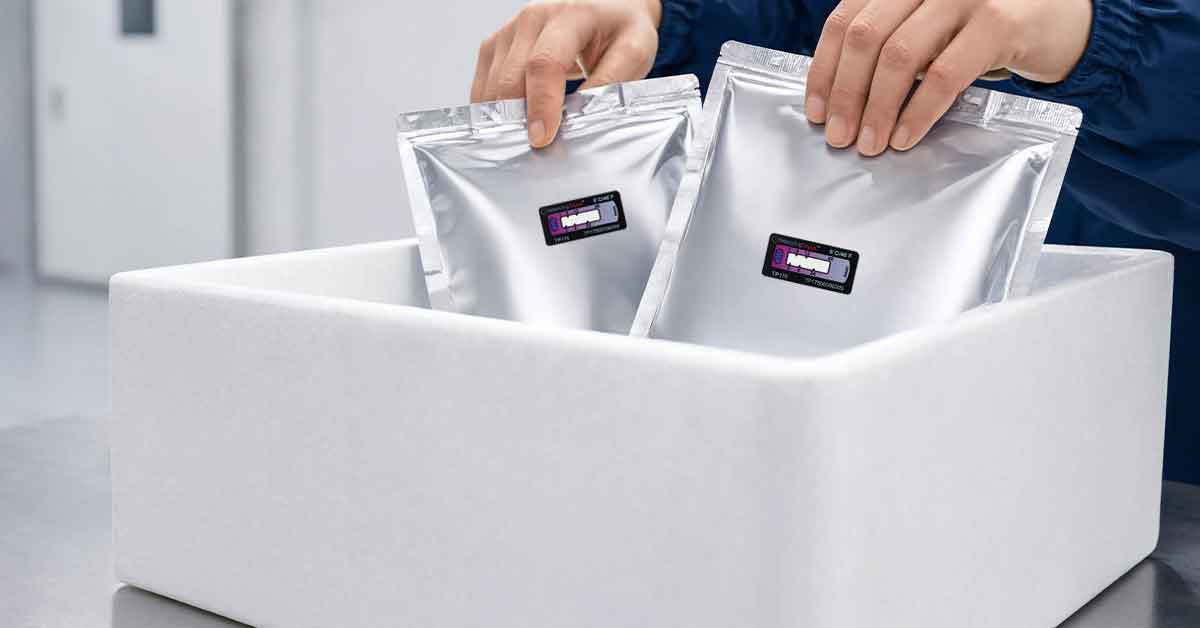
A small temperature and time indicator can often be attached to the product itself, on the primary packaging, not just the outer. An indicator on the outside of a shipping carton can show that the carton has experienced a temperature excursion, but an indicator attached to the primary packaging can provide information about the thermal exposure of the individual product.
This is particularly valuable where a consignment contains many individual units. For example, imagine a consignment of 1,000 temperature-sensitive units in which only part of the load was exposed to excessive heat. If monitoring is limited to an outer carton or a single data logger, it may be difficult to determine exactly which products were affected.
This can potentially result in an entire batch or consignment being discarded simply because a temperature excursion occurred somewhere within it. With smaller scale monitoring, products that have demonstrably remained within the required temperature conditions can be treated differently from those that have experienced a breach, subject of course to the applicable product stability data and quality procedures.
This principle can be especially important for blood products, where unnecessary wastage can have significant consequences. The World Health Organization identifies temperature monitoring as an important part of the blood cold chain and notes that temperature deviations can affect the viability and safety of blood components.
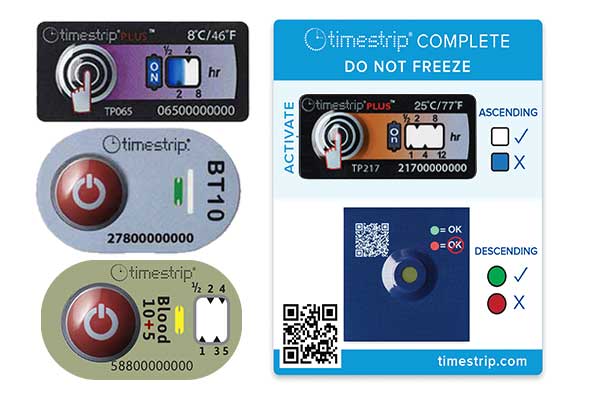
For example, Timestrip Blood Temp 10+ is designed as a small self-adhesive label (just 32 x 19mm) that can be applied directly to a blood bag. It records cumulative exposure above its specified temperature threshold and provides a visual indication that can be read without a reader, software or external power.
When Is a Simple Visual Temperature Indicator Enough?
Not every temperature-monitoring application requires a detailed graph showing temperature against time. Sometimes the critical decision is simply: ‘Is this product still suitable for use?’ A visual time-temperature indicator can answer that question immediately at the point where the decision needs to be made.
Timestrip indicators are designed to provide an irreversible visual indication of temperature exposure, with products available for different temperature thresholds and breach durations. Timestrip PLUS, for example, records cumulative time above a specified threshold rather than simply providing a snapshot of the temperature at the moment it is inspected.
This makes the technology particularly useful further down the supply chain, where a warehouse operative, pharmacist, healthcare professional or receiving department may need to make a rapid decision without access to specialist equipment. Small indicators are not intended to replace appropriate cold-chain management, validated packaging or comprehensive monitoring where those are required. Rather, they provide a simple additional layer of visibility.
Adding a Simple Layer of Visibility to the Cold Chain
In an increasingly complex cold chain, sometimes the most useful technology is the technology that can be put directly on the product, read instantly and understood by anyone handling it.
Explore Timestrip's temperature monitoring solutions across the cold chain.
| VIEW BLOOD TEMP 10+ |
| CONTACT US |