How to Select Blood Bag Temperature Indicators for Pharmaceutical Logistics
In the modern healthcare supply chain, the integrity of sensitive products, from life-saving vaccines to blood bags, is paramount. Because these biological materials are highly sensitive to their environment, any excursion outside of their required temperature range can lead to irreversible damage. To maintain safety and compliance, healthcare professionals are increasingly turning to time and temperature indicators.
However, because different products have unique stability requirements, selecting the right monitoring solution is essential. This guide outlines how to choose the right technology for your specific needs, focusing on the specialized solutions provided by Timestrip®. Timestrip blood bag labels provide an irreversible visual alert should a temperature breach occur.
As well as monitoring the transportation and storage of whole blood, Timestrip’s range of products covers specific uses, enabling the safe transportation of blood components: platelets, plasma and frozen blood products. This goes a long way to maximizing the usability of all these components.
Why Reliable Temperature Monitoring Is Critical for Blood and Pharmaceutical Products
When a product is being shipped within a hospital or surgical facility, there is a risk of temperature excursions. For blood products, the requirements are even more rigid: Red Blood Cells (RBCs) typically require storage between 2°C and 6°C, while platelets must be maintained between 20°C and 24°C with constant agitation. Because these products often show no visual signs of compromise after a temperature breach, non-reversible, objective monitoring is an effective way to ensure patient safety and minimize unnecessary waste.
How to Choose the Right Temperature Indicator for Cold Chain and Blood Storage
Selecting the correct indicator requires balancing threshold accuracy, the need for duration monitoring, and regulatory compliance.
- Cold Chain Temperature Indicators for Vaccines and Pharmaceuticals
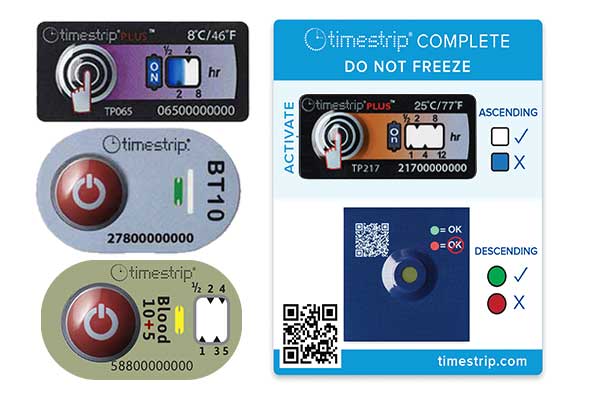
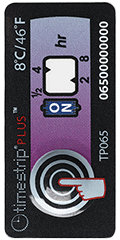
- The Go-To: Timestrip PLUS. This is a standard product for general pharmaceutical logistics. It tracks the cumulative time a product has spent above a specific threshold. If the temperature fluctuates, the indicator pauses; if it rises again, it resumes, providing an accurate total ‘exposure clock’.
- Dual-Threshold Monitoring: Timestrip Complete. Many biologics and vaccines are sensitive to both heat and freezing. Timestrip Complete provides a dual-monitor solution, alerting you if the temperature rises above a maximum threshold or falls below a minimum safe level.
- Temperature Requirements for Specific Blood Products
There are product handling temperature requirements for each type of blood product.
Red Blood Cells: Optimal Temperature: RBCs are typically stored at a refrigerated temperature of 2°C to 6°C (36°F to 43°F).
Platelets: Optimal Temperature: Platelets have unique storage requirements and are typically stored at room temperature, specifically 20°C to 24°C (68°F to 75°F), with continuous gentle agitation. (Ref.)
Fresh Frozen Plasma (FFP): Storage Temperature: -18°C or colder (often -25°C or below, or even -30°C to -65°C, depending on the specific product and guidelines).
Whole blood: Storage Temperature: 2°C to 6°C (36°F to 43°F).
Blood Temp Series: Temperature Indicators for Clinical Blood Transport
-
- Timestrip Blood Temp Series. These reliable temperature indicators are engineered specifically for blood products. They are inert prior to activation, and can be shipped and stored at ambient temperatures, having no special storage requirements. Activation is by simply squeezing the power button blister.
- Blood Temp 6: Temperature Threshold: 6ºC/43ºF - an indicator that shows if the core blood bag temperature has exceeded 6ºC, at which point a blue colour appears in the breach window.
- Blood Temp 10: Blood Temp 10 is a FDA 510(k) Medical Device with a temperature threshold of 10ºC/50ºF, providing the high level of assurance required for hospital quality control and regulatory audits.
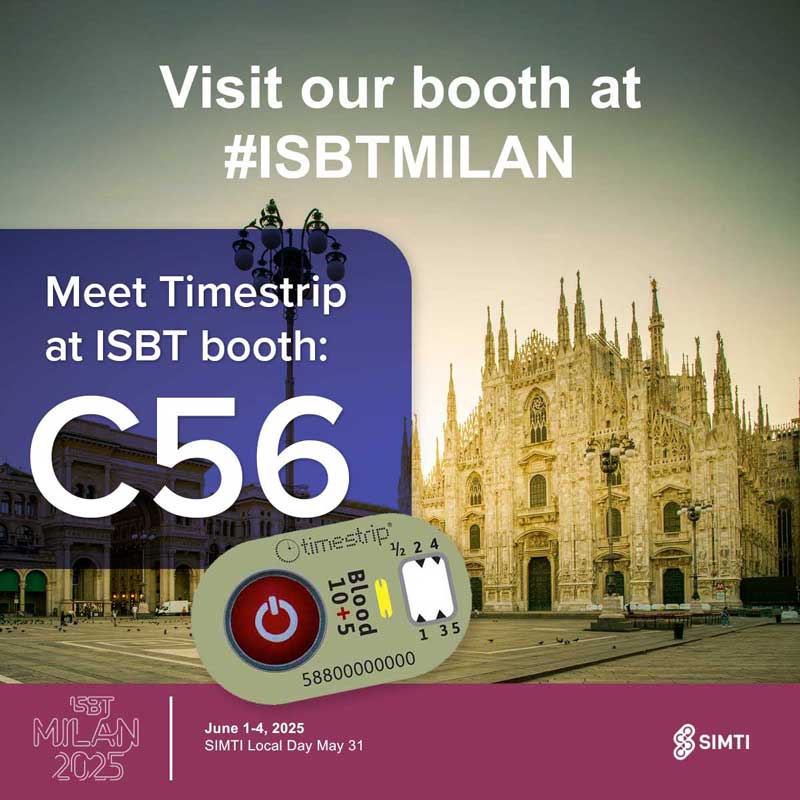
- Blood Temp 10+5 This blood temperature and time indicator shows if blood bag core temperatures have risen during transit in hospital. Monitoring of up to 5 hours of blood bag temperatures over 10ºC are shown with a colour change in a second window.
- Timestrip Blood Temp Series. These reliable temperature indicators are engineered specifically for blood products. They are inert prior to activation, and can be shipped and stored at ambient temperatures, having no special storage requirements. Activation is by simply squeezing the power button blister.
- Blood Temp 10+ is similar to the above, with a temperature threshold of 10ºC/50ºF, but shows cumulative breaches of up to 3 hours.
Key Considerations for Implementing Blood Bag Temperature Indicators
When integrating these indicators into your workflow, keep these three factors in mind:
- Understand Your Thresholds: Always match the indicator’s trigger point to the product's specific stability limits. Using an indicator with a threshold too high or too low can lead to either undetected damage or unnecessary disposal of viable products.
- Prioritize Irreversibility: Ensure your chosen indicator is non-reversible. Once an excursion occurs, the device must provide permanent, auditable proof. This is crucial for internal quality management and external audits.
- Ease of Use: In clinical settings, simplicity is a safety feature. Timestrip products are inert at room temperature, do not require complex pre-conditioning or refrigerated storage before use, and are extremely easy to read an interpret, even by untrained personnel.
Conclusion: Choosing the Right Blood Bag Temperature Indicator
The goal of temperature monitoring is to move away from guesswork and toward absolute certainty. By selecting indicators tailored to the specific needs of your pharmaceutical or blood products, you create a robust layer of defense that protects both your inventory and your patients. Whether through the versatile, cumulative tracking of Timestrip PLUS or the specialized, regulatory-grade reliability of the Blood Temp series, these small labels play an important role in upholding the standards of modern medicine.