
Extreme Temperatures and the Risk to Delayed Goods
At the time of writing, hopes are rising that delays to sea traffic in the Strait of Hormuz (bordering Iran and Oman) will soon be easing. Nevertheless, the backlog of freight will still result in delays for weeks or months to come.
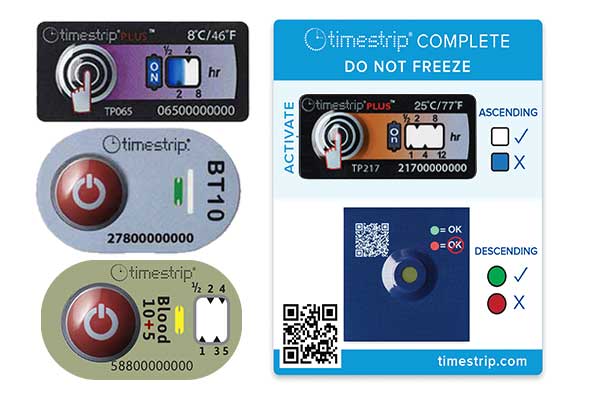
Manufacturers and logistics professionals are looking for ways to ensure that their shipped goods are not subjected to intolerable high temperatures, and many are looking for monitoring solutions such as Timestrip time and temperature indicators for reassurance.
Summer 2026 Temperature Challenges during Shipping
Weather Prediction for the Strait of Hormuz June – Early July 2026
The Strait of Hormuz enters its peak summer heat over the next few weeks. Extreme desert heat can be expected with clear, sunny skies and virtually no precipitation. Daytime Highs will be ranging from 37 °C to 44 °C (99 °F to 111 °F), with the highest temperatures typically being reached in the early afternoon. Even overnight, temperatures will range from 26 °C to 31 °C (low-to-mid 80s °F).
While these figures are perhaps surprising for those living in more temperature zones, this is completely typical for the Strait of Hormuz and the broader Persian Gulf region at this time of year.
These are of course air temperatures, and even harsher conditions will be extant inside metal containers or other non-air-conditioned packaging.
The challenge for sensitive goods
Sensitive products such as foodstuffs and pharmaceuticals, as well as industrial products such as paints and adhesives, will be handled with special care and refrigerated transport being the usual approach. Even where refrigerated (‘reefer’) containers are specified, thermal risk persists due to factors such as port congestion, demurrage delays, power loss during transshipment, or temperature stratification within partially loaded containers.
In addition, not all products are shipped under active temperature control; many rely on passive thermal packaging systems whose performance can degrade over extended transit times or under sustained high ambient conditions.
Monitoring Thermal History of Shipments in Extreme Climates
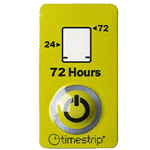
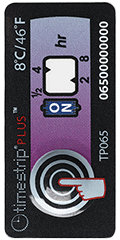
Time and temperature indicators, such as those developed by Timestrip, provide a reliable, single-use means of monitoring cumulative thermal exposure at the unit or pack level. These devices are typically based on predictable liquid-based reaction mechanisms that are engineered to progress at a rate correlated with both time and temperature.
The reaction kinetics are tuned so that the indicator transitions irreversibly once a defined thermal budget—expressed as a combination of temperature threshold and exposure duration—has been exceeded.
This cumulative response is particularly important in real-world logistics scenarios, where product degradation is rarely driven by a single temperature spike but rather by the integration of time above a critical temperature. For example, a pharmaceutical product with a stability limit of 8°C may tolerate brief excursions above this threshold, but prolonged exposure—even at moderately elevated temperatures—can result in loss of efficacy.
Timestrip indicators can be specified to reflect these product specific stability profiles, providing a more meaningful indication of risk than simple threshold alarms.
Integrating Temperature Indicators into Shipments
From an implementation perspective, indicators are typically affixed at the secondary or tertiary packaging level, or directly to primary packs for high-value or high-risk goods. Activation occurs at the point of packing or dispatch, initiating the timing mechanism.
The clear colour change provides a clear, irreversible record of temperature breach that can be assessed instantly at any node in the supply chain without the need for electronic readers or data retrieval.
Quality Assurance
For quality assurance and regulatory compliance, Timestrip temperature and time indicators offer several advantages. They enable lot-level or even item-level verification of temperature exposure, supporting Good Distribution Practice (GDP) requirements, and facilitating risk-based release decisions.
In contrast to more complex electronic data loggers, which provide detailed temperature profiles but are typically deployed at limited sampling points, TTIs can be applied at scale, increasing spatial resolution across a shipment.
Furthermore, TTIs can act as an exception management tool. Shipments flagged by activated indicators can be segregated for further investigation, stability testing or rejection, while unaffected goods can be released without delay. This targeted approach reduces unnecessary waste and supports more efficient quality control workflows.
A reliable temperature monitoring solution
In high temperature corridors such as the Persian Gulf during summer months, where ambient conditions can drive container internal temperatures significantly above external air temperatures, the integration of Timestrip indicators provides an additional layer of verification beyond packaging qualification and route risk assessment.
By directly measuring the thermal history experienced by the product, Timestrip indicators help bridge the gap between predicted and actual conditions.
As supply chains face increasing variability due to climatic extremes and logistical disruption, the ability to quantify and verify cumulative temperature exposure at the point of use is becoming a critical component of robust cold chain and controlled ambient distribution strategies.