Update on Ship-to-Home Pharmaceuticals: State Temperature Regulations and Patient Safety
An introductory article looked at home delivery of medicines. This article examines more recent developments in US state-level requirements for temperature control in home-delivered prescriptions, identifies states whose rules warrant particular attention, and considers what these provisions mean for the use of temperature indicators. It also explores how clear, practical evidence of temperature excursions can help strengthen delivery procedures and protect patients as home-based pharmaceutical care continues to grow.
The growing importance of temperature control in home-delivered medicines
The delivery of prescription medicines directly to patients at home has become an increasingly important part of modern healthcare in many regions. Online pharmacies, established mail-order services and specialist providers supplying treatments for chronic conditions have made home delivery a routine option for millions of people. In the United States, the expansion of digital pharmacy services, including those offered by major retailers and technology companies, has further accelerated this shift towards convenient, patient-centred care.
However, moving prescription medicines from the pharmacy to a patient's doorstep introduces additional challenges for product quality and safety. The final stage of delivery can expose medicines to changing environmental conditions, transport delays and inappropriate storage after a parcel arrives. Unlike a pharmacy or healthcare facility, where storage conditions can be controlled and monitored, the home-delivery environment presents variables that are much harder to manage.
These risks are particularly significant for temperature sensitive pharmaceuticals, including certain vaccines, biologic medicines, insulin products and GLP-1 treatments used in diabetes and weight management. Depending on the specific product, exposure to excessive heat or freezing temperatures can affect stability and reduce the medicine's effectiveness. Many refrigerated medicines require storage between 2°C and 8°C, although the permitted conditions and excursion limits vary by product.
Insulated packaging and temperature-controlled shipping arrangements are essential safeguards, but they cannot eliminate every risk. Unexpected delays, extreme weather or a package left outside in direct sunlight may undermine the protection provided during transit. Furthermore, a medicine that has experienced an unacceptable temperature excursion may show no obvious physical signs of damage.
This creates an important question for pharmacies, delivery providers and patients alike: 'How can the integrity of a prescription be assessed when it reaches its destination'?
Timestrip's role in temperature monitoring
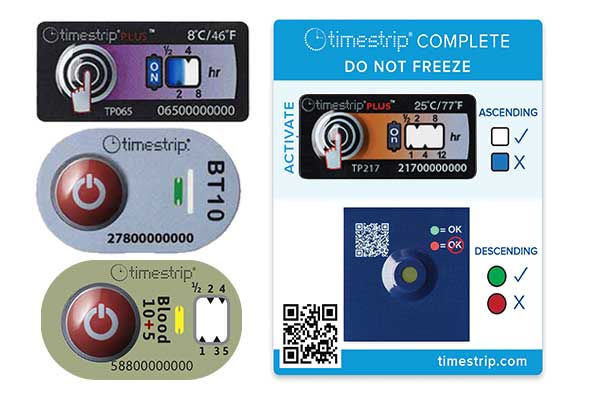
Timestrip temperature and time indicators offer a practical way to help address this challenge. Designed to provide a clear visual warning when specified temperature conditions have been exceeded, these simple, low cost devices can help identify potential problems that would otherwise remain undetected. Depending on the device selected, an indicator may respond to a threshold temperature, record the duration of exposure or provide evidence that a defined temperature limit has been breached.
For pharmacists, such information can support decisions about investigating a delivery, advising a patient or seeking guidance from the medicine's manufacturer. For patients and caregivers, a visible warning can prompt them to contact the dispensing pharmacy before using a potentially compromised medicine. Timestrip time and temperature indicators therefore provide a useful additional safeguard alongside appropriate packaging, validated shipping procedures and clear storage instructions.
Temperature monitoring - an evolving regulatory landscape in the United States
As ship-to-home prescription services expand, the requirements governing temperature-sensitive medicines during delivery deserve closer attention. State pharmacy regulations can impose obligations relating to packaging, storage, transportation, delivery procedures and the communication of special handling instructions to patients.
The precise requirements are not uniform across the country. Some state rules explicitly address temperature maintenance during shipment or delivery, while others focus on packaging, documented procedures or the information supplied to recipients. These distinctions matter for pharmacies and fulfilment providers shipping medicines across state lines, as well as for organisations supplying technologies that support pharmaceutical cold-chain management.
For pharmacy-dispensed prescriptions shipped or delivered to patients at home in the USA, the key distinction is between states that explicitly require temperature control during delivery and those that require only temperature-related warnings or information for patients. Timestrip indicators are valuable in the latter case.
Based on current regulations, seven states warrant particular attention: Georgia, Maryland, Missouri, New Jersey, Pennsylvania, Texas and Utah. The strength and scope of their requirements differ, and some rules apply more directly to mail-order shipping than others.
State-by-state comparison
| State | Main regulation | What it requires |
|---|---|---|
| Georgia | Rules 480-48-.02 and .03 | Mail-order pharmacies must preserve the integrity of medicines requiring temperature control and notify patients about proper storage. Pharmacy delivery must maintain manufacturer-recommended temperatures. Check current status: a 2026 notice proposes repeal of part of this chapter.
GA R&R Chapter 480-48 DELIVERY BY MAIL |
| Maryland | COMAR 10.34.25.03 | Requires packaging to indicate special storage conditions and patient information about temperature sensitive medicines at risk from extreme heat, cold or moisture during shipment or after delivery.
Library of Maryland Regulations |
| Missouri | 20 CSR 2220-2.013 | Pharmacies must have written procedures ensuring safe delivery, mailing and shipping within manufacturer recommended or USP temperature requirements.
LII / Legal Information Institute |
| New Jersey | N.J.A.C. 13:39-5.11 | Requires adequate methods to maintain temperature-controlled conditions during storage, transport and delivery. Where packaging or devices are used, recipients must be told how to detect and report temperature excursions.
Justia |
| Pennsylvania | 49 Pa. Code § 27.18(l)(3) | Allows mailing medicines susceptible to significant deterioration from heat, cold, fermentation or prolonged agitation only when shipped in a way that preserves their integrity, such as with cold packs or other temperature-control devices and sensors.
LII / Legal Information Institute |
| Texas | 22 TAC § 291.12 | For delivery by common carrier, pharmacies must use packaging that maintains an appropriate temperature. For pharmacy employee or same-day courier delivery, medicines must remain within USP- or manufacturer-recommended temperature ranges until received. The rule took effect in June 2024.
LII / Legal Information Institute |
| Utah | Utah Admin. Code R156-17b-608 | Requires appropriate shipping containers and processes to ensure drug stability, potency and appropriate storage temperatures throughout delivery, alongside procedures for compromised or delayed shipments.
LII / Legal Information Institute |
Examples of states most relevant to the use of temperature indicators
Assessing the regulatory requirements for a temperature indicator included in a prescription parcel, these states are the most relevant at present:
- Texas
The rule expressly identifies temperature tags and time-temperature strips as possible packaging measures. This is a particularly direct reference to temperature indicator technology.
- New Jersey and Utah
Both impose explicit obligations relating to temperature maintenance during delivery. New Jersey also addresses recipient instructions for detecting and reporting excursions.
- Missouri and Pennsylvania
Missouri requires documented delivery procedures tied to temperature standards. Pennsylvania explicitly recognises temperature-control devices and sensors as ways to preserve medicine integrity.
Further considerations
- These are state-level pharmacy requirements, not a definitive legal survey of all 50 states. Other states may impose relevant obligations through general pharmacy practice rules, adopted USP standards, or requirements applying to particular medicines.
- Applicability can depend on whether the medicine is delivered by mail, common carrier, same-day courier or pharmacy employee, and whether the pharmacy is licensed in the destination state.
Independent checking of local, regional and national regulations should be carried out before implementing any actions. For a compliance-grade assessment, practitioners should verify the current rule text and effective status with each state's Board of Pharmacy, as these are updated periodically. The National Association of Boards of Pharmacy's state-law resource is a useful starting point.
Timestrip recommends verifying the current wording and status of each state regulation against the relevant Board of Pharmacy or official state regulatory source. In particular, distinguishing between a legal requirement to maintain the correct temperature and an explicit requirement to monitor, record or indicate a temperature excursion.