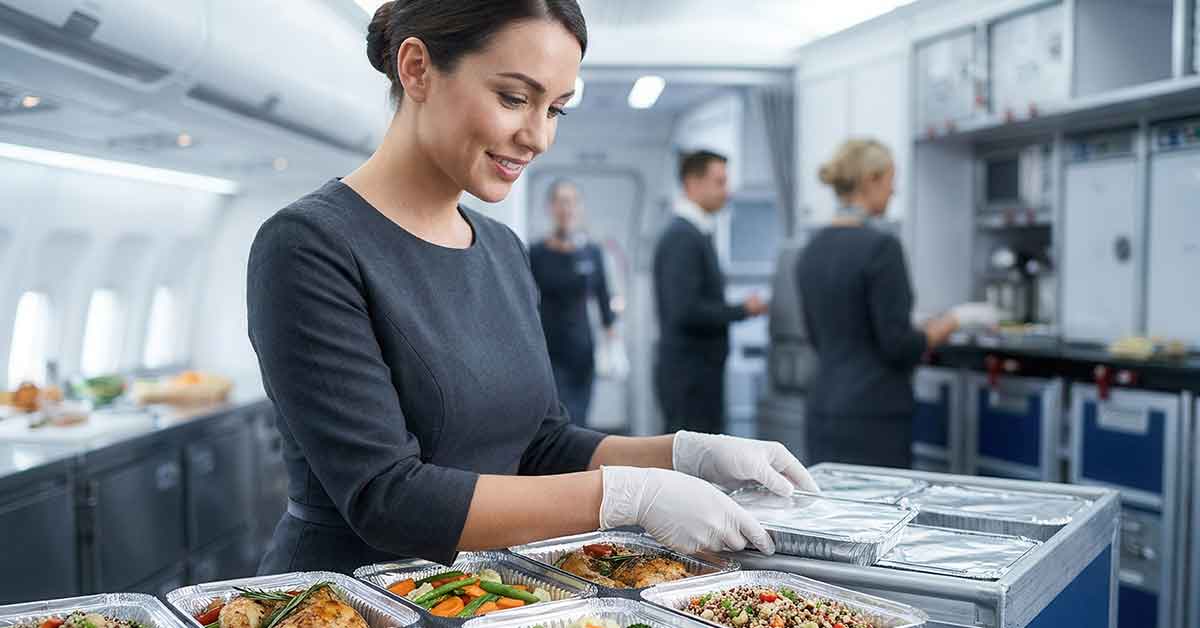
Airline Catering Cold Chain: The Hidden Risk in Every Flight
Every day, airlines serve thousands of meals prepared long before passengers take their seats. Behind every meal is a complex food cold chain involving commercial kitchens, blast chilling, refrigerated storage, transport to the airport, aircraft loading and, ultimately, preparation and service on board.
Temperature control is critical throughout this journey. A temperature excursion may allow harmful bacteria to multiply, potentially compromising food safety and resulting in food waste, operational disruption and reputational damage.
Yet one of the biggest risks in airline catering is not necessarily a failure to monitor temperature. It is the difficulty of proving that the correct temperature has been maintained throughout the process.
From Commercial Kitchen to Aircraft: Where Temperatures Rise
Airline meals are typically prepared in commercial kitchens well before they are served, perhaps up to 12–72 hours before service and blast-chilled to around 5°C. They are then prepared for delivery to the aircraft several hours before departure, and are typically onboard before passengers begin boarding. That creates a long chain of temperature-sensitive handling.
Meals can move between refrigerated storage, catering vehicles, airport facilities and the aircraft itself. Every transfer creates another opportunity for temperatures to rise.
Once onboard, there is another critical stage: reheating. Meals need to reach an appropriate internal temperature before being served, providing an important control against harmful bacteria. But reheating is only one part of the food safety equation. The cold chain before the meal reaches the aircraft is equally important.
The Limitations of Manual Temperature Checks in Airline Catering
Traditional food safety procedures often rely on staff taking thermometer readings at defined points and recording the results manually. A meal or catering cart might be checked at 5°C when it leaves refrigerated storage. But what happened during transportation to the aircraft? Was the cart left on the apron? Was there a delay before loading? Did the temperature rise during a transfer between facilities? A later reading cannot necessarily answer those questions.
Further, the documentation can become separated from the food. Readings may be called out but not recorded, paperwork may be completed retrospectively, or checks carried out during service may not be consistently retrievable. The issue, therefore, is not simply measuring temperature. It is creating reliable evidence that the required temperature controls have been maintained.
Why Airline Catering Needs Better Cold Chain Monitoring
Airline catering is a particularly demanding environment for food cold chain monitoring.
Operations are highly time-sensitive, with meals and catering equipment moving according to aircraft departure schedules. There may be multiple handoffs between catering staff, transport teams, ground handlers and cabin crew. A temperature monitoring solution needs to work within this environment rather than add complexity to it.
This is where a simple visual food temperature indicator can provide an additional layer of protection. Timestrip already identifies airline catering as one of its food-industry applications, alongside fresh seafood, meat, prepared foods, school meals, home delivery and restaurants.
Making Temperature Exposure Visible with Food Temp Indicators
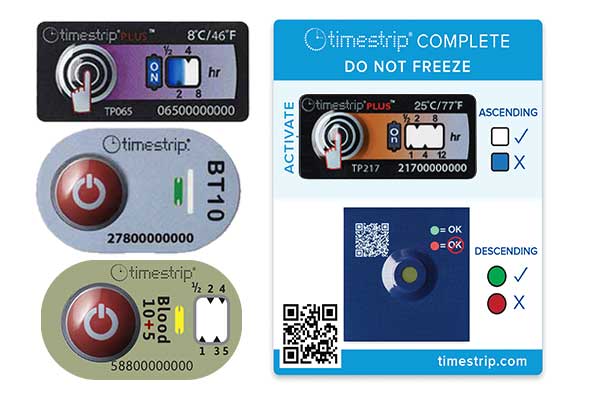
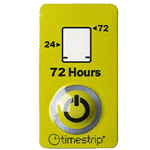
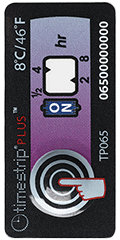
Timestrip Food Temp indicators are designed to provide a simple, visual indication of temperature exposure during storage and transportation. For airline catering, a suitable indicator can be attached to food packaging or a catering carton. Once activated, it monitors exposure to temperatures above a defined threshold.
If the temperature exceeds that threshold for the specified breach period, a coloured indication develops. The result is an immediate visual record that can be checked by food handlers without requiring a reader, software or specialist equipment.
Timestrip’s Food Temp range includes indicators designed around different temperature thresholds, including 5°C, 8°C, 10°C and 3°C, with typical breach windows of 2–4 hours, so the most appropriate indicator can be selected according to the requirements of the food and the particular application.
A Simple Pass-or-Fail Check at Every Handoff
One of the greatest advantages of a visual indicator is its simplicity. At a handoff point, a member of staff does not need to download data, interpret a graph or locate a paper record. They can simply inspect the indicator. A clear result provides confidence that the defined temperature condition has been maintained. A triggered indicator provides an immediate reason to investigate and take the appropriate action under the organisation’s food safety procedures. Timestrip’s Food Temp indicators provide a clear visual pass/fail indication of temperature exposure, while their unique serial numbers provide traceability for auditing shipments. This can be particularly valuable in an airline environment where decisions have to be made quickly.
Supporting HACCP and Food Safety Procedures
Temperature control is an established part of food safety management systems. Hazard Analysis and Critical Control Points (HACCP), for example, is used to identify and control hazards associated with food production, handling and distribution. Temperature indicators can provide additional evidence at critical control points.
Rather than relying solely on a manually completed log, the indicator stays with the product or packaging and records the relevant temperature exposure. Timestrip indicators provide traceable evidence for an audit of supply chain hazards within a HACCP plan by creating a useful link between the physical product and its temperature record.
It can also help organisations to investigate problems more effectively. If a temperature breach is identified, the indicator can help establish that an excursion occurred and provide a starting point for reviewing where in the process the problem may have arisen.
Reducing Unnecessary Food Waste Through Better Temperature Evidence
Temperature monitoring is not only about identifying unsafe food. It can also help prevent good food from being unnecessarily discarded. Without evidence of the actual temperature history, the safest response to uncertainty may be to reject an entire batch, carton or catering load. A product-level or carton-level indicator can provide more targeted information.
Timestrip indicators can help food safety managers make rapid decisions at handoff points, while product-level monitoring can help identify affected food rather than automatically treating an entire shipment as compromised.
For airline catering, where large volumes of meals may be prepared and transported for every flight, even small reductions in unnecessary waste can have significant operational and financial benefits.
Designed for the Realities of the Food Cold Chain
An effective monitoring solution needs to be practical. Timestrip indicators are small, lightweight and single-use. Timestrip PLUS is inactive before activation and can be armed simply by pressing its blister button. No pre-conditioning, cold room or specialist training is required.
The indicators use cumulative breach monitoring. When the temperature rises above the specified threshold, the indicator begins recording exposure. If the temperature subsequently returns below the threshold, the process stops; if it rises again, monitoring resumes from where it stopped.
A simple food temperature indicator provides another layer of visibility. It does not replace established food safety procedures, validated processes or appropriate temperature measurement. Instead, it provides a straightforward way of making temperature exposure visible at the point where a decision
needs to be made. For airlines and catering providers, that can mean better airline catering food safety, stronger food cold chain monitoring, improved traceability and less reliance on paperwork alone. Find out more about Timestrip Food Temp indicators for catering and food logistics.
Find out more about Timestrip PLUS and how it supports pharmaceutical cold chain monitoring.
| VIEW FOOD TEMP RANGE |
| CONTACT US |